
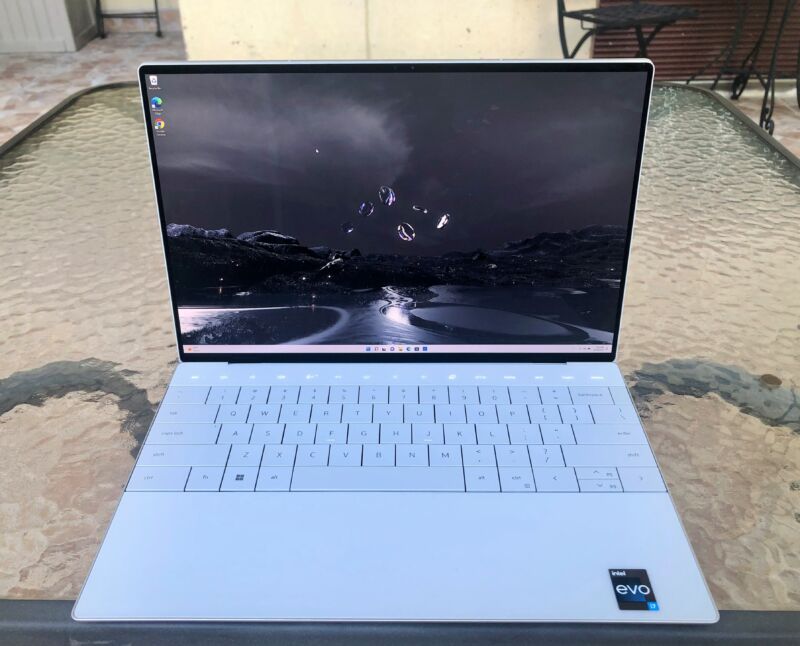
Enlarge / Dell's XPS 13 Plus clamshell laptop. (credit: Scharon Harding)
| Specs at a glance: Dell XPS 13 Plus (9320) | |||
|---|---|---|---|
| Worst | Best | As reviewed | |
| Screen | 13.4-inch 1920×1200 IPS non-touch screen | 13.4-inch 3840×2400 IPS touchscreen or 13.4-inch 3456×2160 OLED touchscreen | 13.4-inch 3456×2160 OLED touchscreen |
| OS | Windows 11 Home | Windows 11 Pro | Windows 11 Home |
| CPU | Intel Core i5-1240P | Intel Core i7-1280P | |
| RAM | 8GB LPDDR5-5200 | 32GB LPDDR5-5200 | 16GB LPDDR5-5200 |
| Storage | 512GB PCIe 4.0 x4 SSD | 2TB PCIe 4.0 x4 SSD | 512GB PCIe 4.0 x4 SSD |
| GPU | Intel Iris Xe | ||
| Networking | Wi-Fi 6, Bluetooth 5.2 | ||
| Ports | 2x Thunderbolt 4 | ||
| Size | 11.63 x 7.84 x 0.6 inches 295.30 x 199.04 x 15.28 mm | ||
| Weight | 2.71 pounds (1.23 kg) | IPS: 2.71 pounds 1.23 kg) OLED: 2.78 pounds (1.26 kg) | 2.78 pounds (1.26 kg) |
| Battery | 55 Wh | ||
| Warranty | 1 year | ||
| Price (MSRP) | $1,300 | $2,360 | $2,000 |
| Other | USB-C to 3.5 mm and USB-C to USB-A 3.0 adapters included, Ubuntu-based Developer Edition available | ||
Dell's XPS 13 laptop has been a staple among Windows ultralights, typically offering decent performance for the price, extreme portability, and good looks.
Apparently, that wasn't enough for Dell, so it released the Dell XPS 13 Plus. Introduced this year (alongside a more traditional 2022 XPS 13), it's a revamped version of the XPS 13 that puts performance over everything else.
Wild design choices allow the system to support a 28 W CPU. With the 2021 XPS 13 carrying a 15 W chip and the 2022 XPS 13 supporting up to a 12 W one, this is a notable achievement. But it's also a case of function over form. To put it simply, using the XPS 13 Plus felt weird. From its tightly spaced keys and capacitive touch function row to its minimal port selection, questionable build quality, and extremely high temperatures, this machine can be frustrating to use for daily tasks.
Read 45 remaining paragraphs | Comments
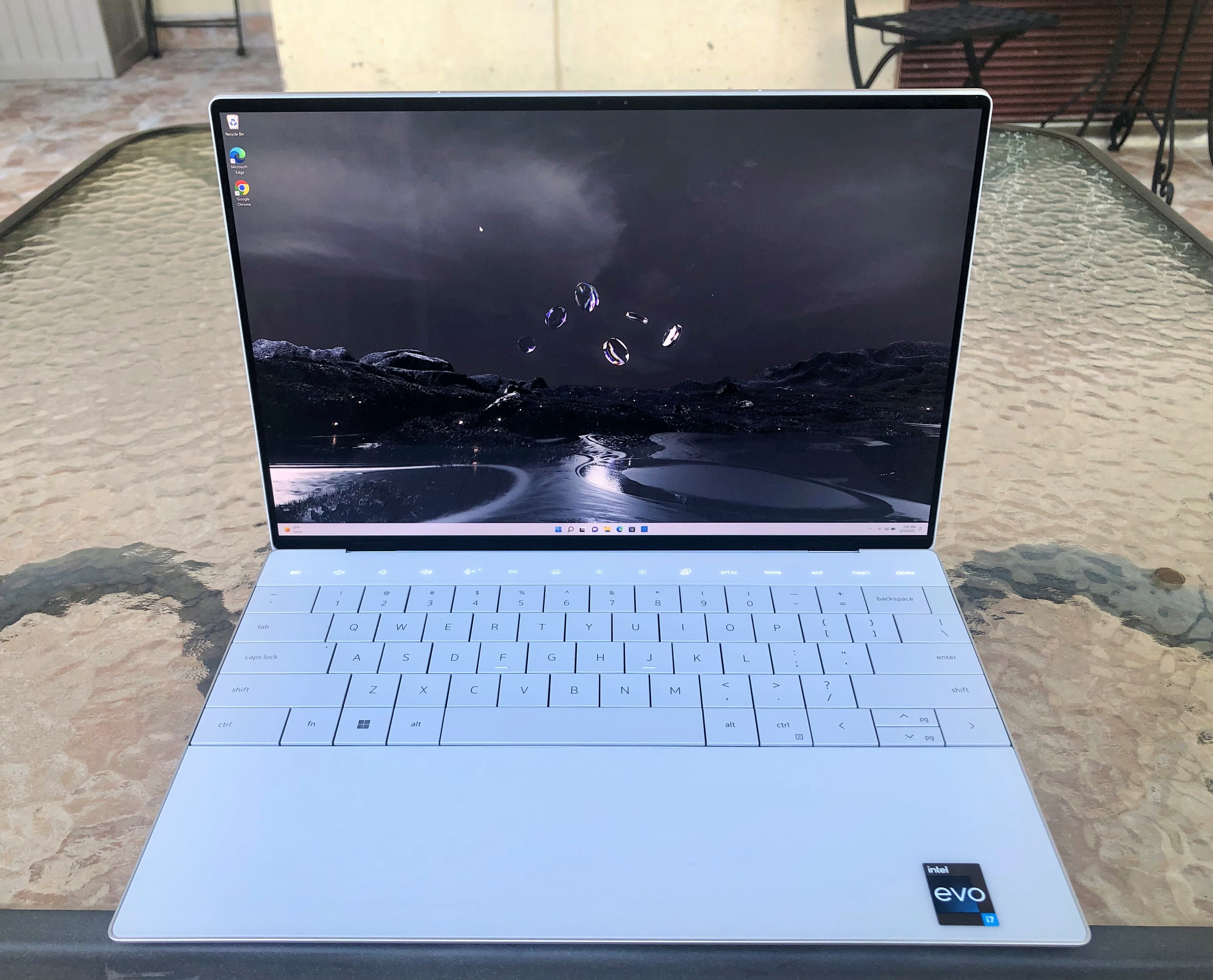
Enlarge / Dell's XPS 13 Plus clamshell laptop. (credit: Scharon Harding)
| Specs at a glance: Dell XPS 13 Plus (9320) | |||
|---|---|---|---|
| Worst | Best | As reviewed | |
| Screen | 13.4-inch 1920×1200 IPS non-touch screen | 13.4-inch 3840×2400 IPS touchscreen or 13.4-inch 3456×2160 OLED touchscreen | 13.4-inch 3456×2160 OLED touchscreen |
| OS | Windows 11 Home | Windows 11 Pro | Windows 11 Home |
| CPU | Intel Core i5-1240P | Intel Core i7-1280P | |
| RAM | 8GB LPDDR5-5200 | 32GB LPDDR5-5200 | 16GB LPDDR5-5200 |
| Storage | 512GB PCIe 4.0 x4 SSD | 2TB PCIe 4.0 x4 SSD | 512GB PCIe 4.0 x4 SSD |
| GPU | Intel Iris Xe | ||
| Networking | Wi-Fi 6, Bluetooth 5.2 | ||
| Ports | 2x Thunderbolt 4 | ||
| Size | 11.63 x 7.84 x 0.6 inches 295.30 x 199.04 x 15.28 mm | ||
| Weight | 2.71 pounds (1.23 kg) | IPS: 2.71 pounds 1.23 kg) OLED: 2.78 pounds (1.26 kg) | 2.78 pounds (1.26 kg) |
| Battery | 55 Wh | ||
| Warranty | 1 year | ||
| Price (MSRP) | $1,300 | $2,360 | $2,000 |
| Other | USB-C to 3.5 mm and USB-C to USB-A 3.0 adapters included, Ubuntu-based Developer Edition available | ||
Dell's XPS 13 laptop has been a staple among Windows ultralights, typically offering decent performance for the price, extreme portability, and good looks.
Apparently, that wasn't enough for Dell, so it released the Dell XPS 13 Plus. Introduced this year (alongside a more traditional 2022 XPS 13), it's a revamped version of the XPS 13 that puts performance over everything else.
Wild design choices allow the system to support a 28 W CPU. With the 2021 XPS 13 carrying a 15 W chip and the 2022 XPS 13 supporting up to a 12 W one, this is a notable achievement. But it's also a case of function over form. To put it simply, using the XPS 13 Plus felt weird. From its tightly spaced keys and capacitive touch function row to its minimal port selection, questionable build quality, and extremely high temperatures, this machine can be frustrating to use for daily tasks.
Read 45 remaining paragraphs | Comments
September 17, 2022 at 05:15PM